For Immediate Release October 8, 2026
Media contacts:
- Greta Anderson, Western Watersheds Project (520) 623-1878, greta@westernwatersheds.org
- Michelle Lute, Wildlife for All, (505) 552-2501, michelle@wildlifeforall.us
- Leia Barnett, WildEarth Guardians, (970) 406-2125, lbarnett@wildearthguardians.org
- Mary Katherine Ray, Rio Grande Chapter Sierra Club, (575) 537-1095, mkrscrim@gmail.com
- Russ McSpadden, Center for Biological Diversity, (928) 310-6713, rmcspadden@biologicaldiversity.org
- Roz Switzer, Sonoran Broadband/Great Old Broads for Wilderness, (303) 887-0409 sonoranbroadband@greatoldbroads.org
Another Mexican Gray Wolf Crosses U.S.-Mexico Border, Underscoring Need for Action Against Border Infrastructure
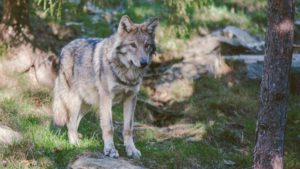
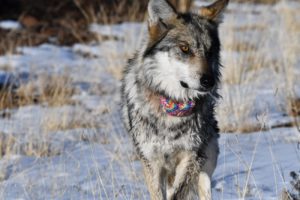
TUCSON, Ariz. – A U.S.-born Mexican gray wolf translocated to Chihuahua, Mexico, in May 2026 crossed north back into New Mexico this week through the state’s remote region known as the Bootheel. Named “Flor”, Spanish for flower, by wolf advocates in Mexico, the former breeding male of the Hardcastle Canyon pack returned to his home state through one of the last unwalled stretches of the international boundary. His movement underscores the need to halt further border wall construction in natural areas of Arizona, New Mexico, and Texas.
Ongoing protests of the border wall in southern Arizona near the town of Lochiel have made the news recently as the Department of Homeland Security uses increasingly violent tactics against the land defenders opposing new construction, and the walls themselves are violence against the natural communities of this region.
“The demonstrations in Lochiel against the border wall are about exactly this: the border walls are devastating to the ecological and social functions of the border region,” said Greta Anderson, deputy director of Western Watersheds Project. “Animals like Flor demonstrate the need to protect the remaining intact habitats from further destruction and harmful land uses.”
“This is larger than one wolf wandering a remnant of open borderlands,” said Roz Switzer, Sonoran Broadband co-leader with Great Old Broads for Wilderness. “The incredibly biodiverse zones along the U.S.-Mexico border are succumbing to ecosystem destruction, severed habitat connectivity and aquifer depletion. The Grandmother cottonwoods toppled in Lochiel, Ariz., and the riparian area they anchored, are the latest victims of the ecocide that is occurring for border barrier and infrastructure construction.”
Flor is the most recent wolf to cross the border, but Mexican gray wolves have traversed the region for thousands of years until they were driven nearly extinct by a government-funded campaign to eradicate livestock predators through shooting, trapping and poisoning. The species was reintroduced in the U.S. beginning in 1998 and Mexico in 2011. Today, wolves are again demonstrating the need to protect cross-border habitat in the shared landscapes where barriers do not block their movements.
Flor is just one of at least four wolves known to use the bootheel area as a corridor in recent years. In 2022, a pair of wolves established a home range spanning both countries within the Peloncillo and Chiricahua Mountains. In April 2026, a male wolf known as Cedar traveled south from New Mexico into Chihuahua and countless more have crossed undetected over the years. Together, these journeys demonstrate the Bootheel remains one of the last functioning connections between wolf habitat on both sides of the border. Indeed, existing barriers have already disrupted wolf movements elsewhere along the border. In 2021, a Mexican gray wolf known as Mr. Goodbar spent four days moving along the border wall near Las Cruces before turning back north. A wolf from Mexico had crossed through that same area in 2017, before the wall blocked the route.
“Flor’s roaming shows why we should be protecting and restoring migration pathways across the border, not destroying them,” said Russ McSpadden, Southwest conservation advocate at the Center for Biological Diversity. “The Trump administration’s dream of a continent-wide border wall is ecological madness.”
“People and wolves alike need room to build their lives, form families, and stay connected to the communities that sustain them,” said Michelle Lute, PhD in wolf conservation and executive director of Wildlife for All. “Border walls rip apart those connections–fragmenting wildlife habitat, dividing Indigenous homelands, and separating human communities. We stand with the peaceful defenders of these shared lands and demand a future that protects the freedom of people and wildlife to roam, live, and thrive.”
“Flor, and those brave border-crossing lobos who preceded him, demonstrate the critical need for big connected, protected landscapes for iconic, native wildlife,” said Leia Barnett, New Mexico conservation lead for WildEarth Guardians. “The international line, and other arbitrary political boundaries, like Interstate-40, are meaningless, and often harmful, to wild wolves. We need to stop imposing our human-centered agendas on wildlife and let lobos roam.”
“An impenetrable border wall is devastating for many wildlife species, not just Mexican wolves like Flor,” said Mary Katherine Ray, wildlife chair for the Rio Grande Chapter of the Sierra Club. “It severs connections to habitat, to food and to water. In this way, the wall threatens their very lives. Surely humans are smart enough to find a way to protect our human-created border without harming the animals who call both sides home.”
Photos of Flor are available for media use, with credit to Fundación Tonkawa/Tonkawa Foundation.